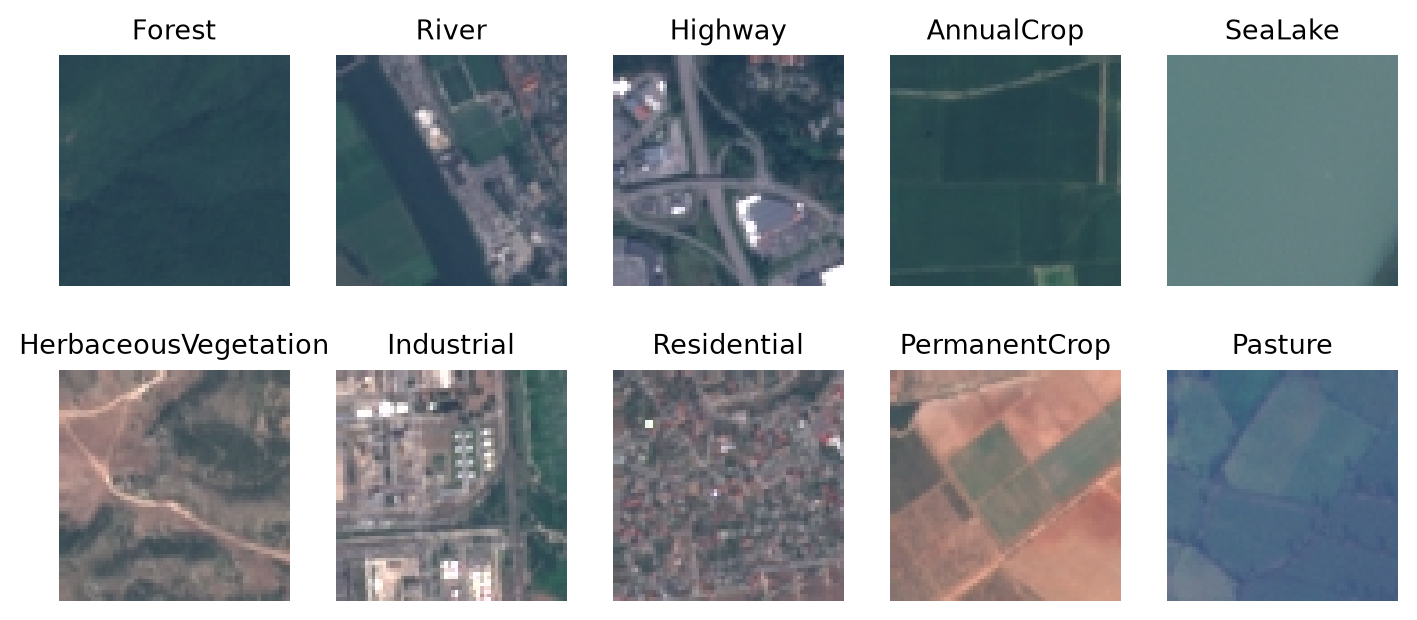
A satellite chip is unstructured data, \(64 \times 64 \times 3\) numbers. A classifier turns it into a variable: built-up or agricultural land, roads, forest, water (Donaldson and Storeygard 2016)
The classifier is a measuring instrument: its mistakes are measurement error in any regression the labels enter, and here they vary with the landscape and the prompt. The classification lecture covers what that does and how to correct it
Two routes, neither of which trains anything: a vision-language model through Ollama (the local LLM lecture, with qwen3.5:4b pulled, or qwen3.5:2b on 8 GB machines) and a downloaded classifier trained for exactly this task (uv sync --extra extras for torch and transformers)
EuroSAT
Vibe-coding Warning!
This material has not yet been fully vetted and checked.
The Data
EuroSAT (Helber, Bischke, Dengel, and Borth 2019): \(27{,}000\) Sentinel-2 chips, \(64 \times 64\) pixels at \(10\) m, ten land-use classes; \(92\) MB on the Hub as cm93/eurosat
load_dataset downloads it once. The test rows are in random order, so the first \(100\) are a sample
import osimport numpy as npimport pandas as pdimport matplotlib.pyplot as pltfrom datasets import load_datasetchips = load_dataset("cm93/eurosat", split="test[:100]")labels = chips.features["label"].namestruth = [labels[i] for i in chips["label"]]print(chips[0]["image"].size, truth[0])
(64, 64) SeaLake
Each observation is \((x_n, y_n)\), an image and a class. No hand-built features
Each chip covers \(640\) m on a side. Some classes are obvious at this resolution; Pasture, HerbaceousVegetation, and PermanentCrop are not, even for a person
A Vision-Language Model
Can a Language Model See?
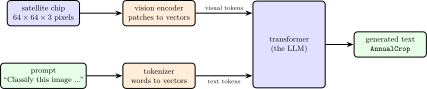
A vision-language model adds a vision encoder that cuts the image into patches and maps each to a vector in the token space. The transformer reads image and text together and generates text
Qwen 3.5, the local LLM lecture’s model, is built this way, so the chat call already accepts images
Two Ways to Connect Pixels and Words
Embedding models (CLIP, and RemoteCLIP for satellite imagery) put images and text in one vector space. Embed the chip and each label, pick the closest: a zero-shot classifier in the spirit of the embeddings lecture
Generative models (Qwen 3.5, Qwen3-VL, GPT-4o, Gemini) put the visual tokens in front of the LLM and generate the label as text, given the image, a question, and the allowed labels
We use the generative route: the local LLM lecture’s chat call with one more content part
Encoding the Image
The chip travels inside the JSON request as a base64 data URL. The question lists the allowed labels, so the class list lives in the prompt, not in the weights
import base64import iofrom openai import OpenAIclient = OpenAI(base_url="http://localhost:11434/v1", api_key="ollama")def image_url(image):buffer= io.BytesIO() image.save(buffer, format="PNG") data = base64.b64encode(buffer.getvalue()).decode()return"data:image/png;base64,"+ dataquestion = ("Classify this satellite image as exactly one of: "+", ".join(labels) +". Answer with the label only.")
Same Client, Same Call, Plus an Image
content is a list of parts, text and image, instead of a string; the rest is the local LLM lecture’s call. temperature=0 makes reruns repeatable, and reasoning_effort="none" skips Qwen’s thinking, which took \(30\) to \(50\) seconds per chip for a few points
def classify(image, model="qwen3.5:4b", examples=()): response = client.chat.completions.create( model=model, temperature=0, reasoning_effort="none", messages=[{"role": "user", "content": [*examples, {"type": "text", "text": question}, {"type": "image_url", "image_url": {"url": image_url(image)}}, ]}], )return response.choices[0].message.content.strip()predicted = [classify(row["image"]) for row in chips]print(np.mean([p == t for p, t inzip(predicted, truth)]))
0.51
No training step, well under a minute for \(100\) chips; examples is for the next slide. Runnable version: eurosat_vlm.py
One Labelled Chip per Class in the Prompt
The text lecture’s one-shot prompt, with images: labelled chips from outside the scored \(100\) go in front of the question, and the weights still never change
pool = load_dataset("cm93/eurosat", split="test[100:300]")pool_truth = [labels[i] for i in pool["label"]]examples = [{"type": "text", "text": "One labelled example of each class:"}]for label in labels: url = image_url(pool[pool_truth.index(label)]["image"]) examples += [{"type": "image_url", "image_url": {"url": url}}, {"type": "text", "text": label}]predicted = [classify(row["image"], examples=examples) for row in chips]
Model
Zero-shot
Ten examples
Qwen 3.5 2B
27%
33%
Qwen 3.5 4B
51%
62%
Qwen 3.8 27B
60%
71%
Qwen3-VL 4B
41%
54%
About ten points for every model, at a few hundred tokens per request. The ViT saw \(21{,}600\) labelled chips. Runnable version: eurosat_vlm_examples.py
A Downloaded Classifier
Weights Somebody Else Trained
The Hub also hosts task-specific classifiers. Haifald/vit-eurosat is a Vision Transformer (\(86\) million parameters) fine-tuned on the \(21{,}600\) training chips; its card reports \(98.7\%\) test accuracy
Three lines with transformers, which the NLP lecture skipped because most of it is about training. pipeline downloads \(340\) MB once, resizes each chip to \(224 \times 224\), and runs on the CPU
from transformers import pipelinevit = pipeline("image-classification", model="Haifald/vit-eurosat")print(vit(chips[0]["image"], top_k=3))
One score per class, \(z = f_\theta(x) \in {\mathbb{R}}^{10}\), and the softmax of the classification lecture
\[
\mathbb{P}(y = k \,|\, x) = \frac{e^{z_k}}{\sum_{j=1}^{10} e^{z_j}}, \qquad \hat{y} = \operatorname{argmax}_k \mathbb{P}(y = k \,|\, x)
\]
Multinomial logit had \(z_k = x^{\top} \beta_k\) with hand-built features. Here \(f_\theta\) is a transformer over \(16 \times 16\) pixel patches, and \(\theta\) has \(86\) million entries fit by cross-entropy on labelled chips, on someone else’s GPU
The VLM has no such head. The classes enter the prompt, and the label comes out as text
Comparing the Models
Accuracy on the Same 100 Chips
Class
\(n\)
Qwen 3.5 2B
Qwen 3.5 4B
Qwen 3.8 27B
Qwen3-VL 4B
GPT-4o mini
ViT
Forest
8
12%
75%
88%
38%
25%
100%
River
13
0%
54%
15%
69%
69%
100%
Highway
7
14%
100%
86%
86%
100%
100%
AnnualCrop
11
0%
0%
18%
55%
36%
100%
SeaLake
17
24%
100%
100%
82%
94%
94%
HerbaceousVegetation
10
0%
0%
0%
0%
0%
100%
Industrial
9
89%
0%
78%
0%
100%
100%
Residential
9
44%
78%
89%
33%
89%
100%
PermanentCrop
9
100%
78%
56%
0%
0%
100%
Pasture
7
0%
0%
86%
0%
43%
100%
All
100
27%
51%
60%
41%
58%
99%
The same chips, the same zero-shot question, temperature=0, September 2026. Qwen 3.8 27B is the \(48\) GB Mac row of the local LLM lecture’s table; GPT-4o mini is the NLP lecture’s hosted model, OpenAI() with the defaults and no reasoning_effort, about \(15\) cents for the \(100\) chips
Where They Disagree
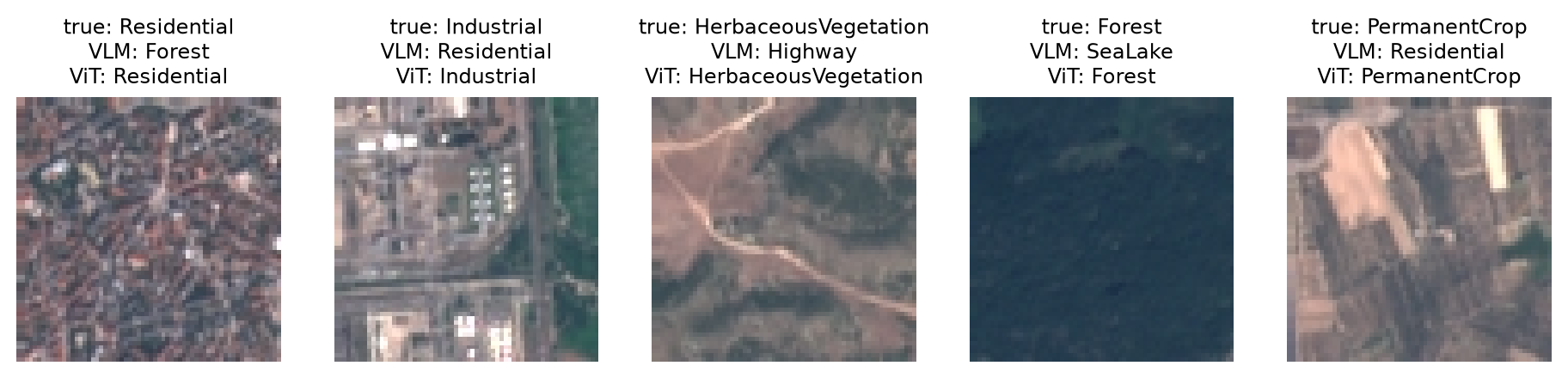
The first five chips the VLM gets wrong, with the ViT’s answer. Read the errors, not only the rate: Pasture for HerbaceousVegetation is harmless for many uses, a lake for a forest is not
Specialized or General?
The ViT was trained for these ten classes and nothing else: \(100\) chips in seconds, a probability per class, fixed outputs. A new question means labelling data and training again
The VLM had no training from us. The classes are words in the prompt, and the same model answers other questions about the same chip; the table is the price
Specialization is not automatic: Qwen3-VL loses to Qwen 3.5 4B, seven times the parameters buy nine points, ten labelled chips about as many, and only the fine-tuned ViT is reliable here
Things to Try and Extra Materials
Ask yes or no about roads, or for JSON attributes with response_format={"type": "json_object"}, and check which chips flip; try qwen3.5:2b, qwen3-vl:4b-instruct, or qwen3.8:27b-mlx, and thinking by dropping reasoning_effort
Aggregate predictions to a region, regress an outcome on the share of built-up land, then estimate \(p_0\) and \(p_1\) from labelled chips and correct the slope (classification lecture)
The tables come from the committed data/eurosat_predictions.csv. Rebuild it with uv run python utilities/build_eurosat_predictions.py, then render with --no-cache