import numpy as np
import matplotlib.pyplot as pltECON526: Problem Set 1 (Solutions)
SOLUTIONS
Instructions
- Ensure you modify the field above with your name and student number above immediately
- Modify directly and do not rename the file as Canvas will automatically append your name to it.
- Submit both the
.ipynband an exportedhtmlversion of this file. - See here for instructions.
- Do not change the filenames. Canvas automatically appends your name/student number to submitted files.
Setup
Install Python (with Jupyter and VS Code)
- See here for instructions and links.
- VS Code is optional but recommended.
Question 1
Modify the next cell with some math text with the Pythagorean theorem (e.g. \(x^2 + y^2 = z^2\))
Question 2
Modify the next cell to create a function which takes the sides of the rectangle and calculates the hypotenuse (i.e., code up \(z(x,y) = \sqrt{x^2 + y^2}\)) then calculate \(z(3,4)\)
# modify hereQuestion 3
Take the following system of equations, build a matrix, and solve for the system of equations using numpy’s linalg.solve function.
\[ \begin{aligned} 2 x_1 + 3 x_2 &= 5 \\ 4 x_1 + 9 x_2 &= 20 \end{aligned} \]
# modify hereQuestion 4
Now take the following system
\[ \begin{aligned} x_1 + 2 x_2 &= 5 \\ 2 x_1 + 4 x_2 &= 10 \end{aligned} \]
Try this with linalg.solve. Why doesn’t it work? If this has a solution, find it and explain.
# modify hereQuestion 5
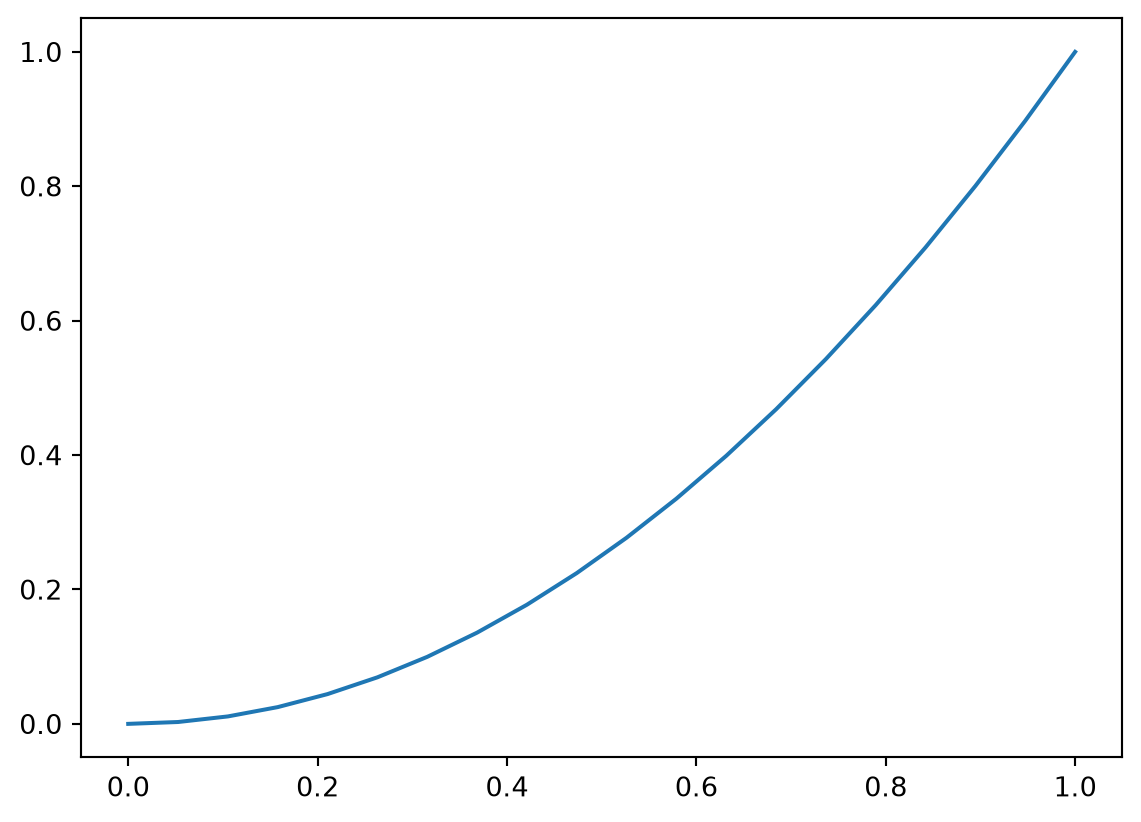
Plot \(f(x) = x^2\) for a grid of 20 points of \(x \in [0,1]\). Hint: You can make a grid with np.linspace(...) and use matplotlib’s plt.plot(...) function.
# modify here
TipSOLUTIONS
# SOLUTIONS
x = np.linspace(0, 1, num=20)
y = x**2
plt.plot(x, y)